
In the recently released recording of President Trump’s “discussion” with Georgia Secretary of State Raffensperger about alleged voter fraud in the state, the President makes more than 100 references to the group of people at the root of every conspiracy theory he peddles: “THEY.”

“THEY” are groups of people that Trump believes were disenfranchised: “substantial numbers of people, thousands and thousands, who went to the voting place on November 3, were told THEY couldn’t vote, were told THEY couldn’t vote because a ballot had been put on THEIR name.”
“THEY” are dubious ballots: “THEY weren’t in an official voter box; THEY were in what looked to be suitcases or trunks, suitcases, but THEY weren’t in voter boxes.”
“THEY” even exploited dead people to vanquish Trump! “The other thing, dead people. So dead people voted, and I think the number is close to 5,000 people. And THEY went to obituaries. THEY went to all sorts of methods to come up with an accurate number, and a minimum is close to about 5,000 voters.”
But Trump’s favorite “THEY” are those invisible forces out to steal the election from him: “this just came up this morning, that THEY are burning their ballots, that THEY are shredding, shredding ballots and removing equipment… THEY supposedly shredded I think THEY said 300 pounds of, 3,000 pounds of ballots.”
Pause for a long sigh by the country’s English teachers…

Okay, now we can continue…
Trump’s “THEY” is what those of in the grammar biz call an “ambiguous pronoun.”
The problem with ambiguous pronouns is that they are… well… ambiguous. They lack a properly-defined or clearly-referenced antecedent (noun that comes before the pronoun… you know, like an unambiguous person, place or thing). Confusing? Let me give you some examples:

Child: “THEY told me I could take an extra piece of chocolate cake!”
Parent: “Who told you that?”
Child: “You know… um… THEY did.”
Parent: “Who is THEY?”
Child: “Those people over there” (points at group of adults standing by the buffet table).
Parent: “Okay, then I’ll just go over there and ask THEM why THEY told you that,” (starts to walk to the buffet table).
Child: (Panics and makes a run for it.)
In this case, “THEY” doesn’t exist. The child made up “THEY” in an attempt to legitimize his, her or their choice to swipe an extra piece of chocolate cake. In a related scenario, a speaker might use “EVERYONE” instead of “THEY” in order to invoke quantity as a means to legitimize his, her or their argument:

Child: “But EVERYONE is eating extra chocolate cake!”
Parent: “Who is EVERYONE?”
Child: “You know… um… EVERYONE!”
Parent: “Name EVERYONE.”
Child: (Pouts and gives up.)
Still don’t get it? Here’s a sad knock-off of Schoolhouse Rock that explains the relationship between antecedents and pronouns:
Yikes, that was painful. And while this video is so 2015 with its demands for cisgender–aligned pronouns, the grammar point is made: if you want to use a pronoun properly, you need an antecedent. Otherwise your pronoun is at best ambiguous and at worst the placeholder for a lie.
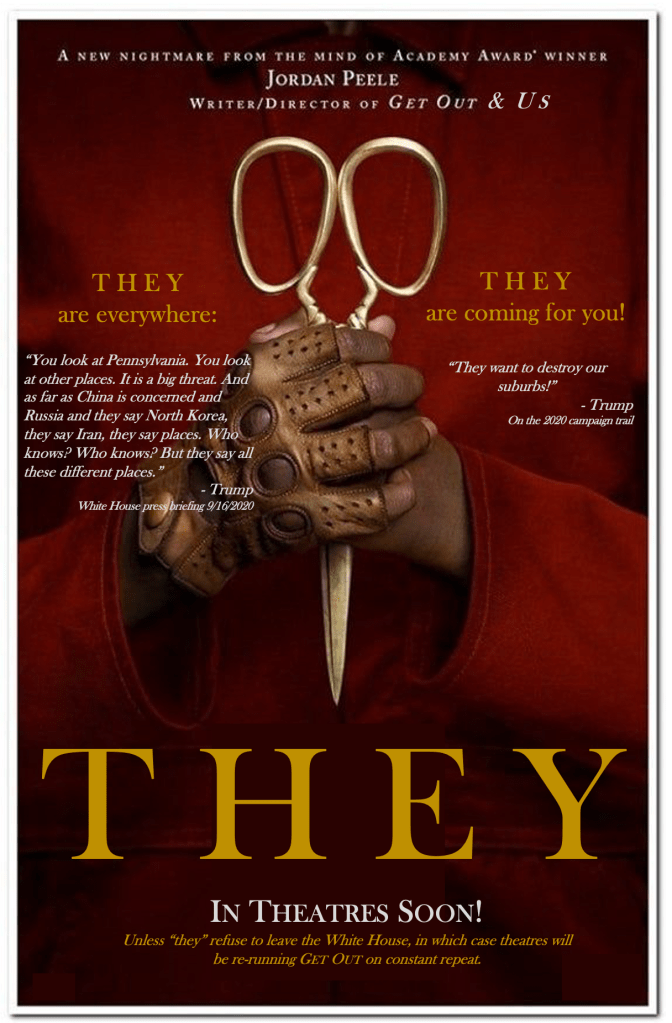
Trump’s pronoun problem is so bad it could inspire Jordan Peele to make a sequel to his 2019 psychological horror film US:
Look, Mr. President, I’ll offer you a deal (you like those, right?). If you and “they” leave office on January 20, 2021 without a tantrum, you can all have an extra piece of chocolate cake. And if someone asks who authorized the extra cake, you can tell them: We the People of the United States.
 wait, what?
I love that movie poster! When do we get another Jordan Peele movie?
LikeLike